
 Egypt Desert Safaris
Best time to visit Egypt Western Desert for photography
As a landscape photographer and senior guide for Egypt Desert Nomad Tours, I spend my life chasing light across the Sahara. Clients always ask me about timing. Let me be clear: Best time to visit Egypt Western Desert for photography? That single question dictates whether you return with award-winning portfolio shots or a ruined camera sensor. The desert does not forgive poor planning. You need to understand the seasonal light, the lunar cycles, and the unforgiving elements that define this harsh environment. My job is to get you to the exact spot when the landscape peaks, but your job is to arrive prepared and informed. This guide will break down exactly what you need to know about navigating and capturing this surreal corner of Egypt.

Lighting the Sahara: The Photographer’s Seasons
Light in the Sahara is a physical force. It shapes the dunes, carves aggressive shadows into the chalk formations, and dictates your entire shooting schedule. The calendar year in the Western Desert splits into distinct photographic seasons, and choosing the wrong one will wreck your expedition.
From October to March, the desert delivers its most pristine conditions. The atmosphere settles, offering clear, crisp skies that make your landscapes pop with sharp, natural contrast. The cooler daytime temperatures mean you will not battle the aggressive heat haze that softens your focal points during the summer. This window is your prime shooting season. The air is stable, allowing for tack-sharp wide-angle shots of the vast expanses stretching between Bahariya and Farafra. You will not have to fight the elements just to keep your eyes open. This is when the desert invites you in, rather than aggressively pushing you out.
Spring, running from March through May, is a gamble I rarely recommend for serious shooters. This season brings the Khamsin—brutal, hot sandstorms that sweep across the Sahara. These winds carry micro-fine silica dust that acts like sandpaper. It will pit your front elements, jam your focus rings, and destroy any unprotected gear. A Khamsin storm reduces visibility to a few meters, stripping the landscape of color, contrast, and depth. While a blinding sandstorm might sound dramatic for photojournalism, it ruins precise landscape work. Your sky turns into a flat, muddy yellow wall. Do not risk your expensive glass during Khamsin season.
Summer, from June to September, is a dead zone. The brutal heat creates massive thermal distortion. Your distant subjects will look like they are melting. The midday light is flat, aggressive, and washes out the subtle textures of the sand dunes. Stick to the cooler months if you want dynamic, publishable images.
Astrophotography & The Milky Way
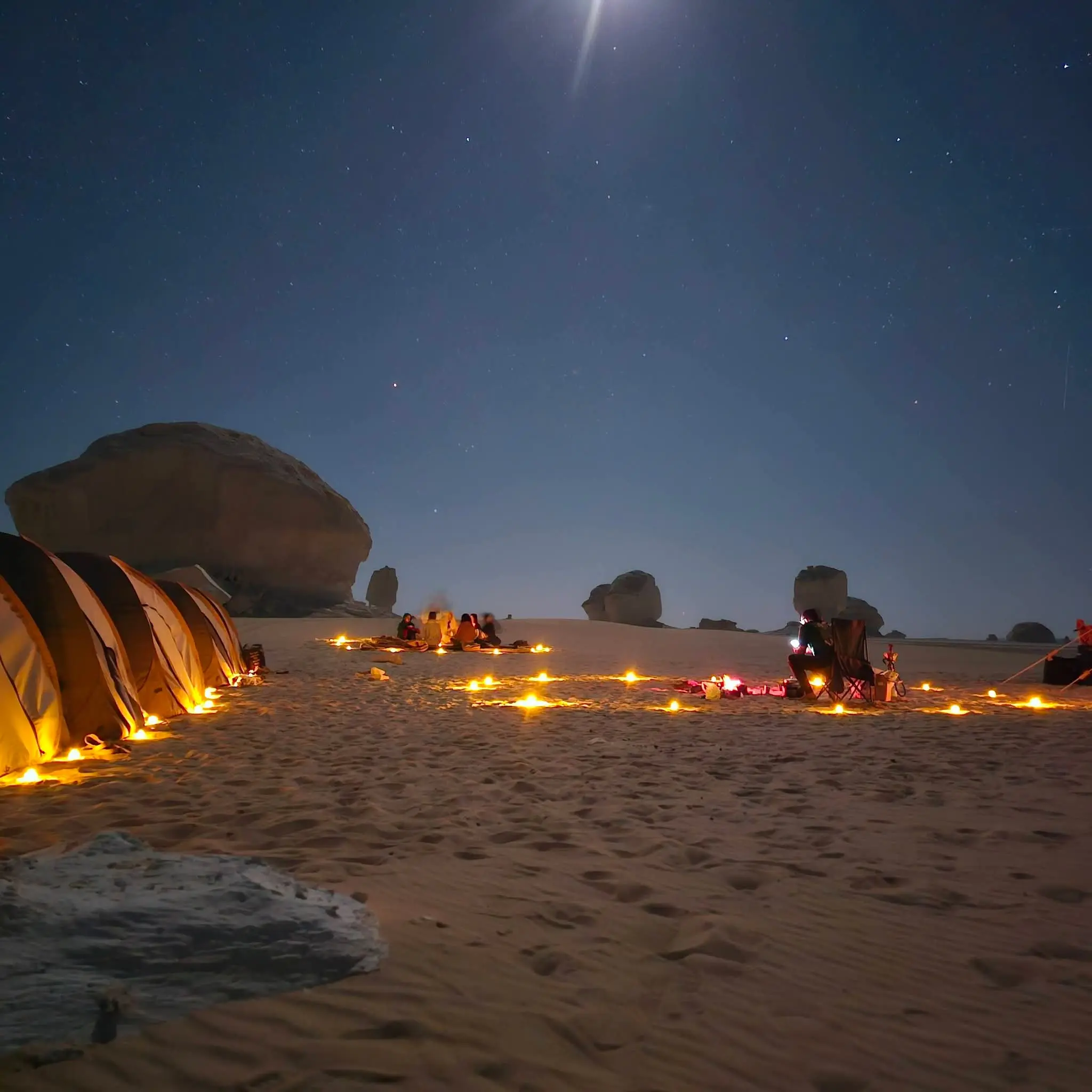
The White Desert is recognized among professionals as one of the most pristine “Dark Sky” zones on the planet. Once you drive a few hours south of the Bahariya Oasis, the artificial light pollution drops to absolute zero. The night sky here is not just a backdrop; it is a massive, glowing subject that demands your full attention.
To capture the Milky Way, you must time your expedition around a New Moon. Even a sliver of lunar light reflecting off the white ground will wash out the faint gases, nebulas, and dust lanes of the galactic core. When you shoot during a New Moon, the darkness is absolute, allowing your sensor to soak in the raw, ancient starlight. You will see stars all the way down to the horizon line.
You need to push your camera to its mechanical limits. Mount your rig on a heavy, wind-resistant tripod. Set your camera to a high ISO, usually starting around ISO 3200 or 6400, depending on your sensor’s noise tolerance. Open your aperture to f/2.8 or wider, and keep your shutter speed around 15 to 20 seconds to prevent star trailing.
The chalk monoliths of the White Desert serve as the perfect terrestrial anchors for astrophotography. Formations like the famous Chicken and Mushroom rock look otherworldly when silhouetted against the cosmos. Some photographers use low-level light painting to bring out the textures of the chalk, brushing the rocks with a dim, warm LED flashlight. The stark contrast between the cold, blue starlight and the warm foreground creates an unforgettable visual anchor.

Iconic Locations & Angles
Every location in the Western Desert requires a different approach to lighting. You cannot shoot the Black Desert and the White Desert the same way. They are polar opposites in geology and texture, demanding a conscious shift in your artistic strategy and visual framing.
The White Desert reveals its true character during the Golden Hour. When the sun dips low on the horizon, the harsh, blinding white of the chalk formations softens. These massive rocks act like natural reflectors, absorbing the warm light of the setting or rising sun. During the Golden Hour, the landscape turns into a surreal dreamscape of soft pinks, deep oranges, and pale purples. You want to shoot low to the ground here, using the wind-rippled sand as a leading line toward the glowing formations. Let the shadows stretch out to create three-dimensional depth.
The Black Desert, located further north, requires breaking traditional photography rules. Here, volcanic dolerite and black basalt rocks cap golden sand dunes. While most photographers pack up their gear when the midday sun hits, this is actually the perfect time to shoot the Black Desert. The harsh, overhead light eliminates soft shadows and creates a brutal, high-contrast environment. The black rocks stand out violently against the bright sand. This is where you shoot punchy, graphic compositions. The intense sun enhances the stark, alien nature of the volcanic cones, giving your images a raw, aggressive edge.
Crystal Mountain is another unique geological stop along the route. The quartz crystals embedded in the rock catch the light brilliantly in the early morning. Shoot macro or close-up details here before the sun gets too high and washes out the subtle refraction.
Gear Survival Guide
The Sahara is hostile to camera gear. The environment actively works to destroy your equipment. Micro-sand is your biggest enemy. It is finer than talcum powder, riding on the slightest breeze, and it will find its way into every dial, button, memory card slot, and sensor cavity.
If you want your DSLR or Mirrorless system to survive the expedition, you must adopt strict field protocols. Never expose your naked lens element to the desert wind. You must use protective UV filters or clear glass on all your lenses. It is much cheaper to throw away a scratched filter than to replace a premium wide-angle lens.
Changing lenses in the open desert is a rookie mistake that will ruin your trip. The wind is unpredictable and relentless. When you need to swap focal lengths, you do it inside the sealed cabin of the 4×4 or inside a zipped tent. Point the camera body downward, make the swap fast, and never leave the sensor exposed to the ambient air.
Here is the mandatory gear list for a desert expedition:
-
Weather-Sealed Camera Body: Ensure all rubber gaskets around your battery doors and lens mounts are intact.
-
UV Filters: Thread one onto every lens in your bag before you leave Cairo.
-
Heavy-Duty Tripod: Skip the lightweight carbon-fiber travel tripods; the desert wind will easily knock them over and smash your rig.
-
Manual Air Blower: Use this constantly to blast dust off your dials and glass. Never use compressed air cans, which can blow sand deeper into the weather sealing.
-
Lens Cleaning Pen & Microfiber Cloths: Keep them sealed in airtight Ziploc bags when not in active use.
-
Silicone Camera Skin: An extra layer of armor against bumps, drops, and abrasive flying sand.
-
Extra Batteries: Cold desert nights will drain your lithium batteries at an alarming rate. Keep spares warm inside your jacket pocket or sleeping bag.
-

Best time to visit Egypt Western Desert for photography

Custom Photography Expeditions
Standard tourist itineraries are useless for professional and enthusiast photographers. A typical tour company rushes you through the landscape to hit an arbitrary schedule. They drop you at the Black Desert at 10 AM, push you through the White Desert at 2 PM, and have you sitting in camp eating dinner when the light is at its absolute best. You will find yourself shooting hastily out the window of a moving Land Cruiser or fighting for space with a dozen other tourists taking mobile phone selfies.
This is exactly why serious shooters book custom photography expeditions. At Egypt Desert Nomad Tours, we build our schedule around the sun, not the clock. A private expedition gives you absolute control over your environment and pacing. We arrive at the prime locations hours before the light peaks. We park the 4×4 in optimal spots, allowing you ample time to scout your compositions, set up your tripods, and wait for the magic to happen.
If you want to spend three hours shooting a single chalk formation under the stars, we stay. If you want to wake up at 4 AM to hike up a volcanic cone in the Black Desert for a sweeping sunrise panorama, we make it happen. We understand that getting the shot requires patience, physical isolation, and immense flexibility.
A dedicated photography tour also means we prioritize the safety of your gear. We know when to pull back during unexpected wind shifts and how to strategically position the vehicles to act as windbreaks for your long-exposure tripod setups. The Western Desert is one of the most visually stunning places on Earth, but capturing its true essence takes time, dedication, and logistical support. Do not waste your trip on a rushed, generic schedule. Book a dedicated expedition, respect the elements, protect your gear, and let the desert light do the rest.


